A battery gigafactory can have hundreds of production machines operating across different manufacturing stages. However, some of its most demanding infrastructure requirements come from systems that do not directly manufacture batteries.
Dry rooms require continuous dehumidification, electrode processing equipment depends on reliable heating and cooling, and formation systems draw and discharge electrical energy during battery testing. These operations create substantial demands on electricity, HVAC, process cooling and supporting utilities.
Unlike conventional industrial facilities, where utility requirements may be relatively predictable, battery cell manufacturing involves closely connected processes with different operating conditions. A disruption in one utility system can affect multiple production stages, product quality and manufacturing output.
India’s battery manufacturing sector is also expanding.
Under the Production Linked Incentive (PLI) scheme for Advanced Chemistry Cell (ACC) battery storage, the government has targeted 50 GWh of domestic manufacturing capacity, with 40 GWh awarded to four beneficiaries as of March 2026.
As manufacturers develop large-scale facilities, utility planning for battery gigafactories becomes essential for managing capital investment, production reliability and long-term operating costs.
This article examines the key utility requirements of battery cell manufacturing plants, how they influence building and infrastructure design, and the practical decisions that should be addressed during project planning.
How Do Utility Requirements Differ Across Battery Manufacturing Processes?
A battery gigafactory typically combines several manufacturing processes, each requiring different utilities and environmental conditions.
For a conventional lithium-ion cell manufacturing facility, production broadly involves electrode manufacturing, cell assembly, electrolyte filling, formation, ageing and final testing.
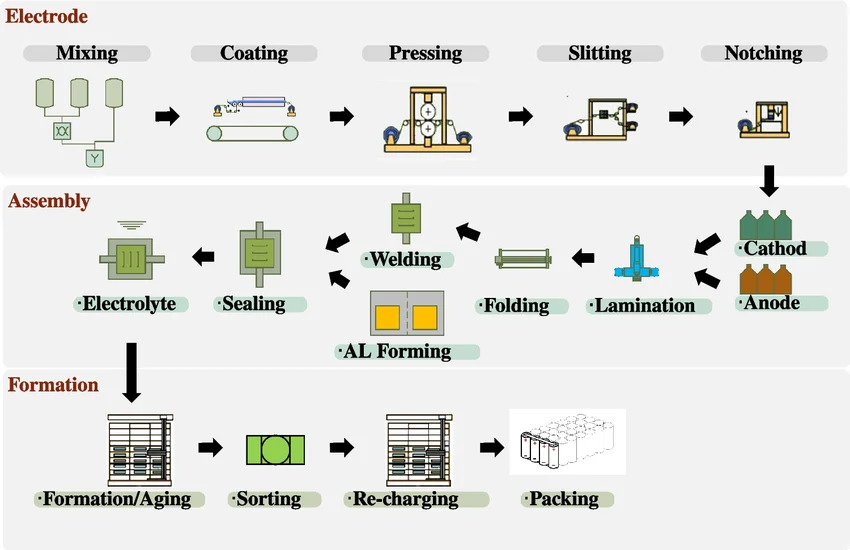
Utility Requirements Across Manufacturing Stages
During electrode manufacturing, coating and drying operations may require substantial thermal energy, process exhaust, cooling and solvent recovery systems, depending on the electrode chemistry and manufacturing technology.
Cell assembly involves processes such as winding or stacking, welding and material handling. These operations require electricity, compressed air and controlled environmental conditions.
Electrolyte filling and certain assembly operations require low-humidity environments to protect moisture-sensitive materials.
Formation and ageing involve controlled charging, discharging and monitoring of battery cells. These stages introduce electrical loads, heat generation and extended equipment operating periods.
The important consideration is that manufacturing capacity in GWh does not directly determine utility capacity.
Two factories with identical annual production capacities may have different utility demands because of their cell chemistry, equipment efficiency, production technology, operating schedules and environmental requirements.
Utility planning should therefore begin with a process-wise equipment schedule rather than applying a general consumption figure to the entire factory.
What Are the Key Electrical Infrastructure and Power Planning Infrastructure?
Electrical infrastructure is among the most significant investments in a battery gigafactory.
Production machinery, dry-room HVAC, chillers, compressors, coating equipment and formation systems can create substantial and varied electrical loads.
Connected Load Versus Actual Demand
The connected load represents the combined rated electrical capacity of installed equipment. However, not all equipment operates at full capacity simultaneously.
For example, electrode drying equipment may operate continuously during production, while welding equipment operates intermittently. Formation equipment follows defined charging and discharging cycles.
Electrical planning should therefore evaluate maximum simultaneous demand, equipment duty cycles, production shifts and operating conditions.
This assessment influences transformer sizing, high-tension distribution, substations, cable infrastructure and power supply arrangements.
Oversizing equipment increases capital expenditure and can reduce efficiency at partial loads. Under sizing may lead to operational restrictions or expensive infrastructure modifications.
Formation and Regenerative Power Systems
Battery formation is a distinctive electrical planning challenge.
During formation, cells undergo controlled charging and, depending on the process, discharging cycles. This requires specialized power electronic equipment.
Some formation systems can recover energy during discharge and return it to a shared DC bus or the facility’s electrical distribution system.
Although regenerative systems can reduce net electricity consumption, they require careful evaluation of bidirectional power flow, power quality, harmonics and electrical protection.
The design team should examine charging schedules, simultaneous discharge conditions and the ability of other facility loads to consume regenerated energy.
Power Reliability and Distribution
Different manufacturing processes have different tolerance levels for power interruptions.
A temporary interruption may stop a material handling conveyor, while a power failure during a sensitive manufacturing or testing operation could affect product quality or require a controlled restart.
Critical equipment should be identified through a process-based reliability assessment.
Depending on the requirements, provisions may include redundant power feeds, UPS systems, backup generators, emergency shutdown arrangements and dedicated electrical distribution.
How Should Dry Room HVAC and Environmental Control Be Planned?
Dry-room infrastructure is one of the defining characteristics of lithium-ion battery cell manufacturing. Moisture-sensitive materials and processes require extremely low humidity to prevent unwanted chemical reactions and maintain manufacturing quality.
Dew Point and Dehumidification Requirements
Dry-room performance is generally specified using dew point, which indicates the moisture content of air.
Many lithium-ion cell manufacturing processes use dry-room conditions around −40°C dew point, while certain operations may require lower values depending on chemistry and process specifications.
Achieving such conditions generally requires specialized desiccant dehumidification systems, air handling equipment and carefully controlled building envelopes. The design must account for outdoor humidity, personnel movement, material transfer, air leakage and internal heat loads.
In Indian locations experiencing high temperatures and monsoon humidity, moisture infiltration can significantly increase dehumidification demand.
Building Design Consideration for HVAC Efficiency
Dry-room performance depends on more than the selected dehumidification equipment. Poorly sealed wall joints, service penetrations and frequently opened doors can introduce moisture continuously.
As a result, the HVAC system must work harder to maintain the required dew point.
Architectural planning should therefore include airtight enclosures, suitable vapor barriers, controlled access points and properly designed material transfer arrangements.
Processes requiring very low humidity can be grouped within dedicated controlled areas, while less sensitive operations can remain outside the dry room. Reducing unnecessary dry-room volume can lower both initial HVAC investment and long-term energy consumption.
What Are the Key Process Cooling, Heating and Supporting Utility Requirements?
Battery gigafactories require several supporting utility systems beyond electrical power and environmental control.
Process Cooling and Thermal Management
Electrode manufacturing equipment, formation systems, power electronics and other machinery generate heat during operation. Cooling may be provided through chilled water, cooling towers, dedicated process chillers or equipment-specific cooling circuits.
Different processes may require different supply temperatures, flow rates and water quality.
Combining all cooling requirements into a single system without evaluating these differences can result in inefficient operation.
A centralized cooling plant may be suitable for large, consistent loads, while decentralized systems can provide flexibility for processes with different operating conditions.
The selection should consider reliability, maintenance, energy efficiency and future expansion.
Process Heating and Exhaust Systems
Electrode coating and drying may require substantial thermal energy. Depending on the manufacturing technology, heating may be supplied electrically or through steam, thermal oil or other suitable systems.
Where solvent-based electrode coating is used, exhaust and solvent recovery infrastructure becomes an important part of utility planning. For example, processes using N-methyl-2-pyrrolidone (NMP) require appropriate solvent handling and recovery arrangements.
These systems influence equipment layouts, ventilation, energy consumption, environmental controls and fire safety provisions.
The utility strategy should therefore be developed alongside the selected electrode manufacturing process.
Compressed Air, Industrial Gases and Water
Compressed air supports pneumatic equipment, automated assembly systems and production machinery.
The design should consider pressure requirements, air quality, moisture removal, redundancy and distribution losses.
Water requirements can include cooling-system make-up, process applications, cleaning, domestic consumption and fire protection. Where process water is required, treatment and quality specifications should be established separately from general utility water.
How Should Utility Integration, Safety and Regulatory Compliance Be Addressed?
Utility systems must be coordinated with building design, production layouts and safety requirements.
For example, a central utility building may house compressors, chillers and electrical equipment, while dedicated process systems may need to be positioned close to manufacturing lines.
The choice affects pipe lengths, distribution losses, maintenance access and future expansion.
Building and Infrastructure Coordination
Utility planning should begin alongside architectural and structural planning.
Transformer yards, electrical rooms, HVAC plants, cooling towers and process equipment require sufficient space, access and suitable foundations. Overhead pipe racks, cable trays and ventilation ducts also influence building clear heights and structural arrangements.
Safety and Environmental Compliance
Battery cell manufacturing may involve flammable solvents, electrolytes, industrial gases, electrical testing and hazardous waste streams.
The design should therefore consider process-specific fire protection, ventilation, gas detection, emergency isolation and safe utility shutdown.
In India, applicable requirements may include state factory regulations, fire safety approvals, electrical safety provisions, and environmental permissions from the relevant authorities.
The Battery Waste Management Rules, 2022, including subsequent amendments, establish obligations for the management of waste batteries.
These requirements should be assessed separately from permissions concerning manufacturing emissions, wastewater and chemical handling.
Engineering recommendations, such as additional utility redundancy or energy recovery, should be distinguished from mandatory statutory requirements.
Conclusion
Effective utility planning for battery gigafactories requires more than calculating electrical loads or selecting HVAC equipment. Battery cell manufacturing involves several interconnected processes with different demands for electricity, heating, cooling, environmental control and supporting utilities.
The central challenge is to develop infrastructure that meets current production requirements while remaining reliable, efficient and adaptable to future manufacturing technologies.
Early coordination between manufacturing technology providers, architects, structural engineers and MEP consultants can help reduce infrastructure conflicts, avoid unnecessary investments and improve long-term operational performance.
For battery manufacturers, utility planning should be treated as an integral part of production strategy rather than a separate engineering activity undertaken after the factory layout is finalized.
VMS provides integrated industrial architecture and engineering consultancy services for manufacturing facilities and their supporting infrastructure.
Connect with our team to discuss utility master planning, electrical infrastructure, HVAC and multidisciplinary engineering requirements for battery manufacturing projects.
Frequently Asked Questions
1. What Are the Main Utilities Required for a Battery Gigafactory?
The main utilities include electrical power, dry-room HVAC, process cooling, process heating, compressed air, industrial gases, water supply and fire protection infrastructure. Additional systems may include vacuum equipment, solvent recovery and specialized wastewater treatment. Requirements depend on the battery chemistry and manufacturing process.
2. Why Do Battery Gigafactories Require High Electrical Capacity?
Battery gigafactories use substantial electrical power for manufacturing machinery, environmental control, process cooling and battery formation. Formation equipment charges and discharges cells under controlled conditions, while dry-room systems may operate continuously.
3. How Can Utility Costs Be Reduced in Battery Manufacturing?
Utility costs can be reduced through efficient HVAC systems, heat recovery, improved building airtightness, regenerative formation equipment and optimized cooling and compressed air systems.
4. How Should Utilities Be Planned for Future Gigafactory Expansion?
Utility planning should consider both initial production capacity and the facility’s ultimate development potential. Modular equipment, reserved utility corridors, additional electrical distribution provisions and suitable plant space can support phased expansion.