A solar cell manufacturing line may operate with precisely calibrated equipment, controlled process temperatures, and automated material handling systems. Yet small amounts of contamination can still affect cell efficiency, manufacturing yield, and long-term reliability.
Dust particles, metallic impurities, chemical residues, and moisture can interfere with sensitive manufacturing processes. Some defects may become visible during production testing, while others may only affect the performance of solar cells after prolonged operation.
This makes contamination control an important consideration in solar cell manufacturing facility design.
This article examines cleanroom and contamination control requirements in solar cell manufacturing, with particular attention to facility planning, HVAC engineering, environmental zoning, material handling, and operational reliability.
Why Is Contamination Control Important in Solar Cell Manufacturing?
Solar cell production involves multiple processes that modify the surface and electrical properties of silicon wafers. These include cleaning, texturing, doping, passivation, contact formation, metallization, and testing.
Contamination introduced during these stages can affect the electrical characteristics of the finished cell.
Different Types of Contamination
Airborne Particle Contamination
Dust and microscopic particles may settle on wafer surfaces, equipment, or handling systems. Depending on their size, composition, and the process involved, these particles can contribute to surface defects, coating irregularities, or electrical performance losses.
Metallic and Chemical Contamination
Metallic impurities can introduce defects that increase charge-carrier recombination, reducing the efficiency of solar cells. Chemical residues and unwanted substances may also interfere with surface treatment, deposition, or contact formation.
Moisture and Surface Contamination
Moisture, ionic residues, and contamination from handling materials can affect sensitive surfaces and contribute to long-term reliability problems.
A 2025 study published in Solar Energy Materials and Solar Cells investigated contamination associated with TOPCon and heterojunction (HJT) cells. Under the study’s damp-heat testing conditions, certain contaminants were associated with relative power losses of 10–16% after 1,000 hours.
The researchers identified handling materials, including gloves, cassettes, and vacuum grippers, as possible contamination sources. These results represent specific experimental conditions, not typical losses across manufacturing facilities.
The findings highlight an important point: contamination control must extend beyond the air inside the manufacturing building. Equipment surfaces, handling practices, materials, and cleaning procedures also require attention.
What Cleanroom Standards and Classifications Apply to Solar Cell Manufacturing?
Cleanrooms are controlled environments designed to limit airborne particles and, where required, other environmental parameters.
The widely used ISO 14644 series provides a framework for cleanroom classification, design, testing, and monitoring.
ISO 14644-1 classifies air cleanliness based on airborne particle concentration. It does not, by itself, establish acceptable levels of metallic, chemical, or surface contamination.
How Should Cleanroom Classifications Be Selected?
Cleanroom classifications range from ISO Class 1 to ISO Class 9, with lower numbers representing stricter airborne particle limits.
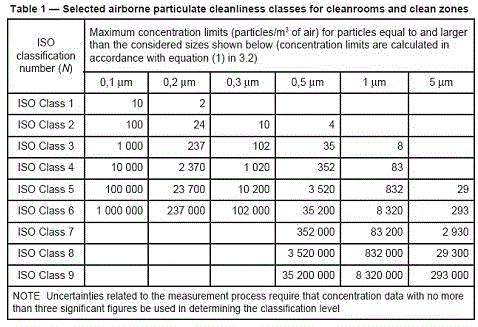
However, there is no single ISO cleanroom classification that applies universally to all solar cell manufacturing facilities.
Different manufacturing stages may require different levels of environmental control. A wafer handling or sensitive deposition area may require tighter contamination controls than a general inspection, packing, or utility area.
The appropriate classification should be determined using process requirements, equipment supplier recommendations, contamination risk assessments, and production quality objectives.
Controlled Environments Versus Classified Cleanrooms
Not every production area needs a formally classified cleanroom.
Some processes may operate within a temperature-controlled and filtered industrial environment, while sensitive operations may require classified clean zones or localized protection.
This distinction is particularly important for large solar cell factories, where the total manufacturing floor area can be substantial.
How Should Cleanroom Layout and Contamination Control Zones Be Planned?
Cleanroom design begins with understanding how materials, personnel, equipment, and contaminants move through the facility.
Separation of Manufacturing Zones
Production areas should be divided according to their contamination sensitivity and operational requirements.
For example, chemical processing, wafer handling, deposition, metallization, inspection, and packaging may have different environmental requirements.
Processes that generate fumes, particles, or chemical vapors should be appropriately separated from sensitive manufacturing operations.
However, segregation should not create unnecessary movement or interrupt the production sequence. The objective is to balance contamination control with efficient material flow.
Personnel and Material Movement
People, packaging materials, maintenance tools and production equipment can introduce contaminants into controlled areas.
Depending on the required cleanliness level, facilities may incorporate gowning rooms, airlocks, material transfer areas, and controlled access points.
Material movement should also be planned to minimize unnecessary handling and repeated transitions between areas with different cleanliness requirements.
For automated manufacturing lines, wafer carriers, conveyors, and robotic handling systems should be evaluated for particle generation and cleaning compatibility.
Building Materials and Architectural Detailing
Architectural finishes play a direct role in maintaining cleanroom performance.
Walls, floors, ceilings, doors, and service penetrations should be designed to minimize particle accumulation and allow effective cleaning.
Depending on the zone, this may involve smooth and non-shedding finishes, sealed joints, suitable floor coatings, and carefully detailed wall-to-floor junctions.
Materials must also be compatible with the chemicals and cleaning procedures used in the facility.
An often-overlooked consideration is maintenance access. Poorly positioned service panels or inaccessible utility connections may require frequent entry into controlled production zones, increasing contamination risks during maintenance.
What Are the Key HVAC and Environmental Control Requirements?
HVAC systems are central to cleanroom performance because they control air filtration, airflow distribution, temperature, humidity, and pressure relationships.
However, cleanroom HVAC design should not be based only on the desired ISO classification. Equipment heat loads, process exhaust, personnel occupancy, local climate, and operational patterns must also be considered.
Air Filtration and Airflow Management
High-efficiency particulate air (HEPA) filters are commonly used where high levels of airborne particle control are required.
The filtration arrangement, supply airflow, return air locations, and air distribution strategy should be selected according to the cleanliness requirements and contamination sources.
Sensitive processes may benefit from localized unidirectional airflow or enclosed clean environments rather than uniformly high airflow throughout the entire production hall.
Air change rates should be established through engineering assessment rather than applying a fixed value to every manufacturing area.
Temperature and Humidity Control
Temperature variations can affect equipment stability, manufacturing consistency, and certain process conditions.
Humidity may influence electrostatic discharge, moisture-sensitive materials, and surface contamination behavior.
The required temperature and relative humidity limits should therefore be obtained from process equipment specifications and manufacturing quality requirements.
Pressure Differentials and Process Exhaust
Pressure relationships help control the movement of air between adjoining spaces. Sensitive clean zones are often maintained at a higher pressure than surrounding less-clean areas to limit contaminant entry.
However, areas handling hazardous chemicals or gases may require negative pressure or dedicated containment to prevent harmful substances from spreading. These requirements must be coordinated carefully.
For example, an improperly balanced exhaust system can disturb cleanroom pressure conditions, increase infiltration, and affect temperature control.
Cleanroom HVAC and process exhaust systems should be designed together, not as independent engineering packages.
The same coordination is necessary for make-up air, chemical exhaust, gas cabinets, scrubbers, and emergency ventilation systems.
How Can Contamination Be Controlled During Operations and Maintenance?
A cleanroom that performs well during commissioning may not maintain the same conditions once production begins.
Personnel movement, equipment servicing, material transfers, and routine cleaning can introduce contaminants. Effective contamination control therefore requires both suitable infrastructure and well-defined operating procedures.
Cleaning and Material Handling Procedures
Cleaning methods should be selected according to the type of contamination and the materials being cleaned.
For example, wiping a surface may remove visible dust but may not adequately remove ionic or chemical residues. Similarly, unsuitable cleaning materials can introduce additional particles or unwanted substances.
Reusable wafer carriers, handling tools, gloves, and maintenance equipment should be evaluated for cleanliness and compatibility with production processes.
Environmental Monitoring and Maintenance
Cleanroom performance should be verified through a monitoring programme appropriate to the manufacturing process.
ISO 14644-2 provides guidance for monitoring cleanroom performance in relation to airborne particle concentration. Monitoring plans should consider contamination risks, operating conditions, and changes to the facility.
Depending on the process, monitoring may include airborne particle counts, pressure differentials, temperature, humidity, filter performance, and selected surface or chemical contamination measurements.
These measurements should be linked to defined alert levels, investigation procedures, and corrective actions.
Another important consideration is maintenance planning. Filter replacement, equipment servicing, and utility modifications should be arranged to minimize contamination and production disruption.
Conclusion
Cleanroom and contamination control requirements in solar cell manufacturing should be determined by the sensitivity of the production process rather than by applying a uniform cleanliness standard across the factory.
Air filtration and environmental control are important, but they represent only part of the solution. Building layout, material handling, equipment interfaces, surface cleanliness, process exhaust, and maintenance practices also influence contamination risks.
For project owners and engineering teams, the priority should be to identify contamination-sensitive processes early and develop an integrated strategy that supports manufacturing quality without introducing unnecessary infrastructure or operating costs.
Planning a Solar Cell Manufacturing Facility?
VMS provides integrated architecture and engineering services for solar manufacturing facilities. Connect with our team to discuss cleanroom planning, environmental control, and industrial infrastructure requirements.
Frequently Asked Questions
1. Is a Cleanroom Mandatory for Solar Cell Manufacturing?
There is no universal requirement for every solar cell manufacturing facility to operate entirely within a classified cleanroom. The need for classified cleanrooms or controlled zones depends on manufacturing technology, process sensitivity, equipment specifications, and applicable project requirements.
2. Which ISO Cleanroom Classification Is Required for TOPCon Solar Cell Manufacturing?
There is no single prescribed ISO classification for all TOPCon manufacturing processes. Cleanliness requirements vary across wafer preparation, deposition, passivation, metallization, and other production stages. The appropriate classification should be determined through process-specific contamination assessments and equipment supplier requirements.
3. How Does Contamination Affect Solar Cell Efficiency?
Particles, metallic impurities, and chemical residues can interfere with silicon surface properties, passivation layers, and electrical contacts. Depending on the contamination type and manufacturing stage, this may increase electrical losses, reduce cell efficiency, or contribute to long-term reliability problems.
4. What Is the Difference Between Cleanroom HVAC and Conventional Industrial HVAC?
Conventional industrial HVAC primarily focuses on thermal comfort, ventilation, and heat removal. Cleanroom HVAC additionally controls airborne particle concentrations and airflow patterns, and may maintain specific pressure, temperature, and humidity conditions to protect sensitive manufacturing processes.