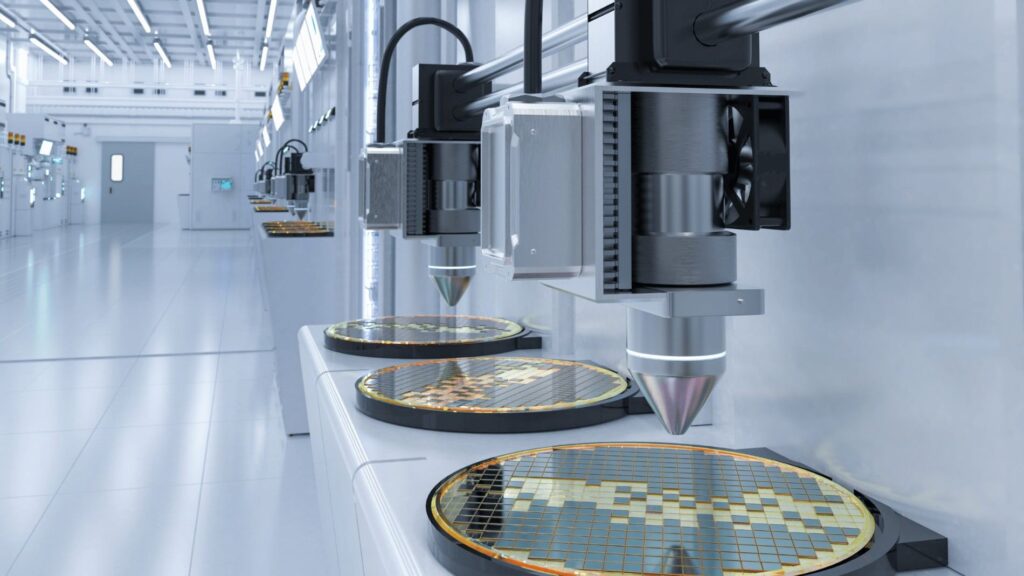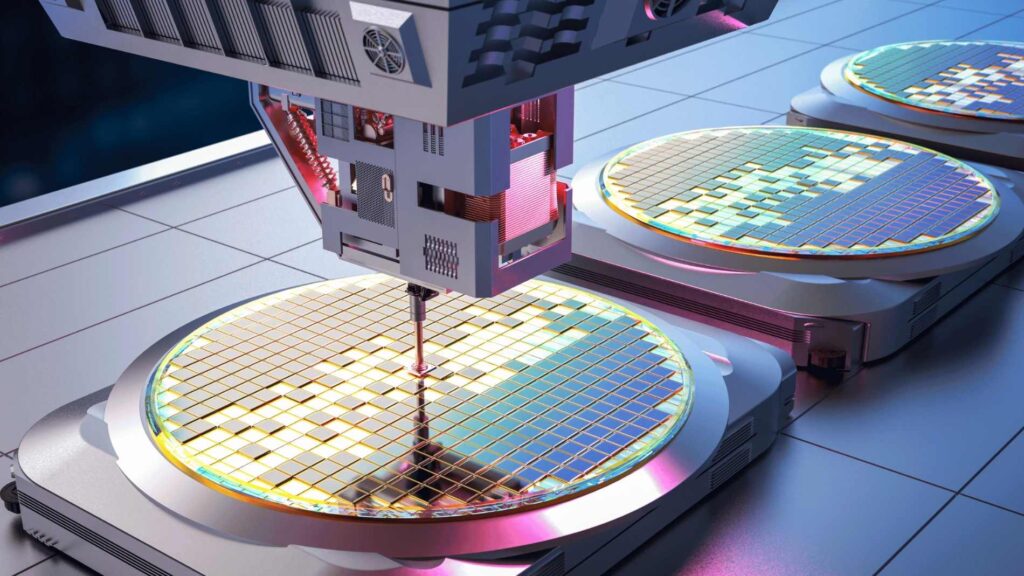
A solar wafer manufacturing facility may have sufficient production capacity on paper, yet still experience delays, material damage, and operational inefficiencies because of poorly planned equipment arrangements and material movement.
Unlike conventional manufacturing, solar wafer production involves handling heavy silicon ingots and progressively converting them into thin, fragile wafers. Each production stage has different requirements for equipment access, material transport, cleaning, and inspection.
The layout must therefore accommodate more than a sequence of machines. It should support efficient production flow, minimize unnecessary handling, and provide adequate space for utilities, maintenance, and future expansion.
This article examines the key considerations for planning solar wafer manufacturing facility layouts.
How Does the Wafer Manufacturing Process Influence Factory Layout?
Factory layout planning begins with understanding the complete production sequence.
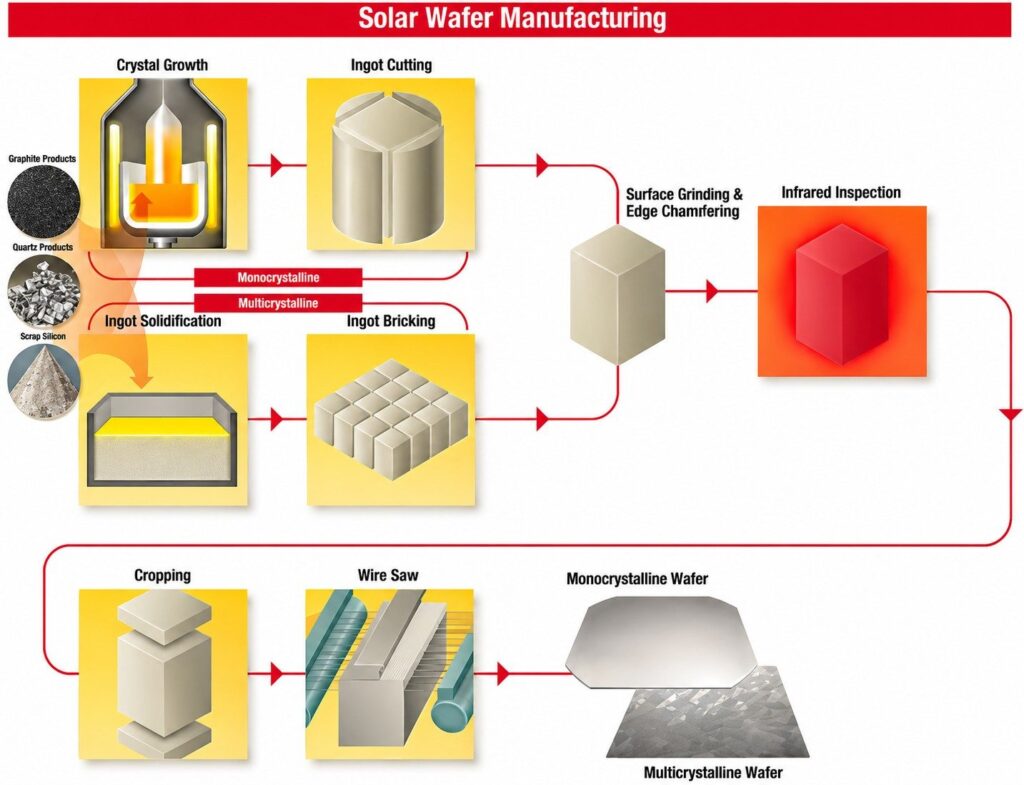
In a typical crystalline silicon wafer manufacturing facility, silicon ingots undergo inspection, cropping, squaring or grinding, slicing, cleaning, sorting, and packaging. The exact sequence depends on the equipment and production technology.
Each stage requires different equipment configurations and material handling arrangements.
Separating Heavy and Fragile Material Handling
During initial processing, silicon ingots are heavy and require suitable lifting and transportation systems.
After diamond wire slicing, wafers become thin and fragile, making them more sensitive to vibration, impact, and excessive handling.
This transition should influence the factory’s material movement strategy.
Heavy ingot processing areas may require overhead lifting equipment, forklifts, or automated transport systems. Wafer handling areas may use specialized carriers, conveyors, robotic systems, or automated guided vehicles.
The layout should minimize intersections between heavy-material transport and fragile wafer movement.
Production Sequence and Buffer Areas
Equipment throughput may vary between cropping, grinding, slicing, and cleaning operations. Without suitable buffer areas, temporary delays at one process can interrupt upstream or downstream operations.
However, excessive buffer storage increases floor space requirements and work-in-progress inventory. Buffer capacities should therefore be established using equipment cycle times, expected downtime, production schedules, and material handling requirements.
What Are the Key Considerations for Equipment Arrangement and Production Zoning?
Equipment arrangement should support manufacturing flow while maintaining safe and practical operating conditions.
Equipment Footprints and Maintenance Access
A common planning mistake is arranging equipment using only its operating footprint.
Diamond wire saws, grinding machines, cleaning equipment, and inspection systems require additional space for loading, unloading, servicing, and component replacement.
Utility connections, electrical panels, maintenance doors, and equipment removal routes must also be considered.
For large equipment, installation and replacement access should be evaluated before finalizing building openings and circulation routes.
Separating Wet and Dry Operations
Wafer slicing and cleaning involve cutting fluids, water circulation, filtration, and wastewater collection.
These areas should be planned with appropriate drainage, water-resistant finishes, and access to treatment infrastructure.
Inspection, sorting, and packaging operations generally require cleaner and drier conditions.
Separating wet processing from sensitive downstream operations can help reduce contamination risks and improve housekeeping.
This does not necessarily require fully independent buildings. Proper zoning, drainage arrangements, material transfer controls, and environmental management may provide sufficient separation.
How Should Material Flow and Internal Logistics Be Planned?
Material flow should be evaluated from incoming ingot receipt to finished wafer dispatch.
The shortest travel distance is not always the most efficient arrangement. A route that reduces distance but creates congestion or repeated handling may perform poorly during actual operations.
Material Movement and Automation
Automated material handling systems can reduce manual intervention and improve consistency, particularly in high-volume manufacturing facilities.
However, automation requires adequate aisle widths, transfer points, charging or power infrastructure, equipment interfaces, and maintenance access.
The choice between manual, semi-automated, and automated handling should be based on production volume, equipment compatibility, and lifecycle costs.
Preventing Cross-Movement and Congestion
Separate routes should be considered for incoming ingots, finished wafers, consumables, waste materials, and maintenance activities.
Where possible, material routes should avoid unnecessary crossings between production stages.
For facilities operating continuously, logistics planning should also consider shift changes, equipment servicing, and peak material movement periods.
A layout that performs well during normal production should remain functional during maintenance or temporary equipment shutdowns.
How Do Utilities and Building Infrastructure Affect Facility Layout?
Utility infrastructure can significantly influence equipment arrangement.
Wafer slicing requires process water or cutting fluid, cooling, filtration, compressed air, electrical power, and wastewater collection. Locating utility systems close to major demand areas can reduce distribution distances and simplify maintenance.
However, utility equipment should not obstruct production circulation or restrict future machinery replacement.
Structural design should consider equipment loads, vibration sensitivity, floor tolerances, and material handling systems.
An often-overlooked issue is the relationship between production expansion and utility access. A layout may have available floor space for additional machines but insufficient space for new piping, cable trays, or maintenance activities.
Conclusion
Effective solar wafer manufacturing facility layout planning requires an understanding of both the production sequence and the changing characteristics of materials during processing.
Heavy ingots, fragile wafers, wet processing equipment, and precision inspection systems cannot all be planned using the same material handling approach.
For project owners, the priority should be to establish equipment requirements, production flow, maintenance access, and utility interfaces before finalizing the building layout.
A well-coordinated facility can help reduce material damage, improve operational efficiency, and accommodate future manufacturing requirements.
Frequently Asked Questions
1. What Is the Typical Production Flow in Solar Wafer Manufacturing?
A typical process includes ingot inspection, cropping, grinding or squaring, diamond wire slicing, cleaning, inspection, sorting, and packaging. The exact sequence depends on the manufacturing technology and equipment configuration.
2. Why Is Material Handling Important in Solar Wafer Production?
Silicon ingots are heavy, while sliced wafers are thin and fragile. Inappropriate handling can increase breakage, contamination, and production losses. Suitable transport systems and carefully planned movement routes help protect materials throughout production.
3. How Much Space Is Required for a Solar Wafer Manufacturing Plant?
There is no universal space requirement. The total area depends on production capacity, equipment dimensions, automation, buffer storage, utility infrastructure, and expansion plans.