A small metal particle entering a battery cell during manufacturing may appear insignificant. However, contamination at sensitive stages can contribute to internal defects, electrical short circuits and potential cell failure.
Battery cell manufacturing involves several processes where product quality depends on controlling the production environment. Airborne particles, moisture, equipment-generated contamination and material handling practices can all influence manufacturing consistency.
This makes environmental control an important consideration when planning a battery manufacturing facility. However, not every production area requires the same level of cleanliness, and cleanrooms should not be confused with dry rooms.
Effective cleanroom design for battery cell production requires an understanding of the manufacturing process, contamination risks, air filtration, humidity control, production layouts and supporting engineering systems.
This article explains how these requirements influence industrial facility design and what manufacturers should evaluate to develop clean and efficient production environments.
What Are the Cleanroom Requirements for Battery Cell Production?
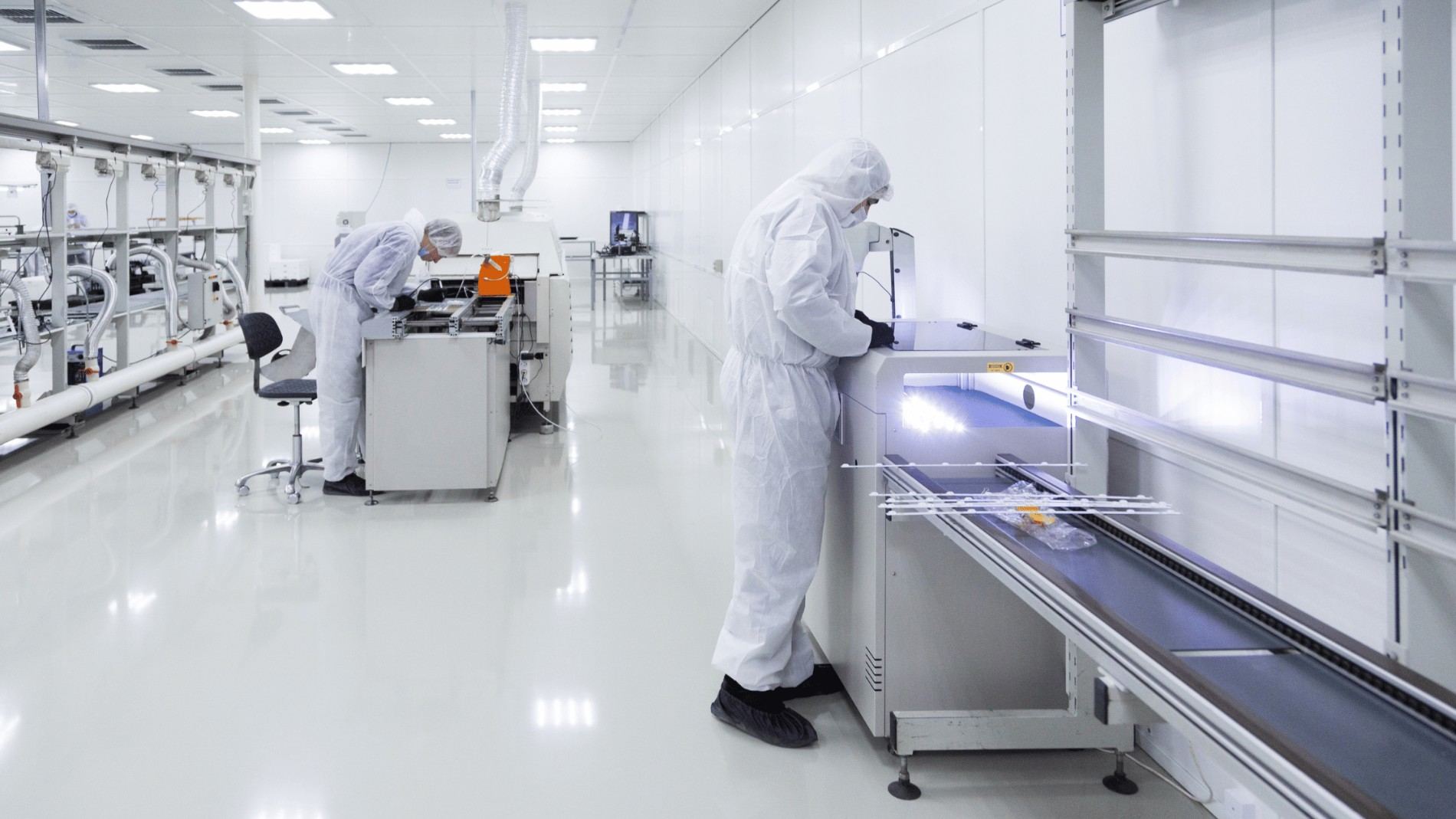
A cleanroom is a controlled environment designed to limit airborne particle contamination. It uses filtration, airflow management, controlled access and suitable construction materials to maintain specified cleanliness conditions.
In battery manufacturing, contamination can originate from electrode materials, equipment wear, handling operations, personnel and surrounding production activities. The consequences depend on the contaminant’s size, composition and where it enters the manufacturing process.
What Manufacturing Processes Require Cleanrooms?
- Electrode manufacturing involves mixing, coating, drying, calendaring and slitting. These operations can generate particles through material handling, cutting and equipment movement.
- Cell assembly processes, including winding, stacking, tab welding and sealing, can be particularly sensitive because electrode surfaces and internal components may remain exposed.
- Electrolyte filling also requires controlled environmental conditions to protect product quality.
However, the necessary cleanliness level varies by process. Some operations may need dedicated cleanrooms, while others may be adequately managed through localized clean zones, enclosed machinery or source extraction.
The correct approach is to identify where contamination can enter the product and how effectively it can be controlled.
How Are Cleanroom Classification and Environmental Requirements Determined?
Cleanroom design begins with establishing measurable environmental requirements. The most widely recognized reference for airborne particle cleanliness is ISO 14644-1.
Understanding ISO Cleanroom Classes
ISO 14644-1:2015 classifies cleanrooms according to airborne particle concentrations measured at specified particle sizes.
Lower ISO class numbers indicate stricter airborne particle limits.
For example, at particle sizes of 0.5 micrometers and larger:
| Cleanroom Class | Maximum Particles per m³ |
| ISO Class 5 | 3,520 |
| ISO Class 6 | 35,200 |
| ISO Class 7 | 352,000 |
| ISO Class 8 | 3,520,000 |
These are classification limits for the stated particle size (0.5 µm – micrometers), not recommended cleanliness classes for every battery manufacturing operation.
A battery manufacturer should select the required class according to process sensitivity, contamination risk and production equipment specifications.
Specifying an unnecessarily stringent class can increase HVAC capacity, construction complexity and operating costs without delivering corresponding improvements in product quality.
Difference Between Cleanrooms and Dry Rooms
Although the terms are sometimes used interchangeably, cleanrooms and dry rooms serve different purposes.
- A cleanroom primarily controls airborne particle concentration.
- A dry room primarily controls moisture content, generally expressed through dew point.
Certain battery manufacturing processes require both.
For example, cell assembly may need low particle concentrations and very low humidity. Such spaces require integrated filtration and dehumidification systems.
Battery manufacturing equipment suppliers such as KUKA specifically develop robotic systems for cleanroom and dry-room conditions, including designs that limit particle emissions from moving equipment.
ISO classification alone does not establish humidity requirements. These must be specified separately according to the battery chemistry and manufacturing process.
What Are the Key Consideration for HVAC, Filtration and Airflow Design?
The HVAC system is central to maintaining cleanroom performance. Its purpose extends beyond cooling the production area.
It must control particle concentration, distribute filtered air, maintain suitable pressure relationships and support stable operating conditions.
Air Filtration and Distribution
Cleanrooms commonly use high-efficiency particulate air (HEPA) filtration to remove airborne particles. The arrangement of supply and return air points influences how effectively particles are removed from sensitive production areas.
Some operations may benefit from unidirectional airflow over exposed products, while others can use appropriately designed mixed airflow. The choice should depend on equipment geometry, contamination sources and the required cleanliness level.
Air changes per hour can provide an initial design reference, but they should not be selected using a universal battery manufacturing value.
The required airflow should be established through cleanliness targets, particle generation estimates and equipment arrangements.
Pressure Differentials and Air Leakage
Cleanrooms often maintain positive pressure relative to less clean adjoining spaces to reduce the entry of contaminated air. However, pressure relationships must be evaluated carefully where processes involve hazardous chemicals, dust or flammable vapors.
For example, a process enclosure requiring hazardous vapor containment may need negative pressure relative to its surroundings, even when the wider production area is positively pressurized for product protection.
The design should distinguish between protecting the product from contamination and protecting personnel from process hazards.
Door openings, equipment penetrations and material transfer points can disturb pressure relationships. Airlocks, interlocked doors and suitable transfer arrangements help maintain more stable conditions during production.
Temperature and Humidity Control
Battery manufacturing processes may require stable temperature and humidity to maintain material properties and production consistency.
Moisture-sensitive cell assembly and electrolyte filling operations can require specialized desiccant dehumidification systems.
In India, outdoor temperature and humidity variations can significantly influence HVAC loads, particularly during summer and monsoon conditions. The system should therefore be designed using relevant local weather conditions rather than relying only on average annual temperatures.
Where low dew points are required, building airtightness and moisture infiltration control become especially important.
Cleanroom filtration and dry-room dehumidification should be designed together when both environmental requirements apply.
How Should Architectural Planning Support Contamination Control?
A cleanroom’s performance depends on how the production space is planned and constructed. Even a well-designed HVAC system can struggle to maintain cleanliness when material flow, personnel movement and equipment arrangements are poorly organized.
Production Zoning and Material Movement
Production areas should be grouped according to contamination sensitivity and process requirements. For example, particle-generating activities such as slitting and cutting may require source extraction or physical separation from sensitive cell assembly operations.
Material movement should follow a logical production sequence while minimizing unnecessary transfers between controlled and uncontrolled environments.
Personnel changing rooms, material airlocks and dedicated maintenance access can reduce contamination introduced through daily operations.
A frequently overlooked issue is packaging. Cardboard, wooden pallets and other particle-generating materials should be assessed before being introduced into sensitive cleanroom areas.
Where practical, materials can be transferred into clean-compatible containers before entering controlled production zones.
Construction Materials and Surface Finishes
Cleanroom walls, ceilings and floors should be durable, easy to clean and resistant to particle shedding.
Common design approaches include smooth wall panels, sealed joints, suitable floor finishes and flush-mounted services.
Construction details should minimize horizontal ledges, exposed insulation and inaccessible areas where dust can accumulate.
Service penetrations for electrical cables, compressed air and process utilities must be appropriately sealed.
Equipment selection is equally important. Moving machinery, robotic systems, conveyor belts and other components can generate particles through friction and wear.
A cleanroom cannot compensate for equipment that continuously releases contamination near exposed battery materials.
How Can Cleanroom Performance Be Verified and Maintained?
Cleanroom performance must be verified during commissioning and maintained throughout the facility’s operating life. Achieving the required particle concentration before production begins does not necessarily guarantee the same conditions when machinery and personnel are operating.
Testing and Commissioning
ISO 14644-3:2019 provides test methods for evaluating cleanroom performance, including airflow and other controlled-environment parameters.
Testing may be performed under as-built, at-rest or operational conditions, depending on the agreed qualification requirements.
The commissioning plan should establish acceptance criteria for particle counts, airflow, pressure differentials, temperature and humidity.
For combined cleanroom and dry-room environments, dew point performance must also be verified separately.
Where sensitive manufacturing processes are involved, measurements should be taken at representative production locations rather than relying entirely on readings near the air handling equipment.
Continuous Monitoring and Maintenance
ISO 14644-2:2015 provides a framework for monitoring cleanroom performance related to airborne particle concentrations.
Depending on the manufacturing requirements, monitoring may include airborne particle counters, differential pressure sensors, temperature sensors and dew point measurement.
These systems can be integrated with a Building Management System (BMS) or manufacturing monitoring platform.
However, monitoring should support operational decisions rather than simply collect data.
Alarm thresholds, investigation procedures, cleaning schedules and corrective actions should be defined before production begins. Filter replacement, airflow balancing and equipment maintenance should also be planned to avoid unnecessary production interruptions.
For multidisciplinary industrial projects, VMS Consultants‘ architecture and engineering approach is relevant to coordinating controlled environments with building design, utilities, production layouts and maintenance infrastructure.
How Can Energy Efficiency and Future Expansion Be Considered in Cleanroom Design?
Cleanrooms can consume substantial energy because they require continuous air circulation, filtration and environmental control. When low-humidity conditions are also required, desiccant dehumidification and regeneration systems introduce additional energy demand.
The objective should therefore be to achieve the required environmental performance without unnecessarily increasing the volume of controlled space or the intensity of air treatment.
Energy Efficient Cleanroom Operation
One effective strategy is to provide higher cleanliness levels only where the manufacturing process requires them.
Localized clean zones or enclosed equipment may sometimes offer a more efficient alternative to upgrading an entire production hall.
Airflow optimization, efficient fans, heat recovery and appropriately controlled HVAC equipment can also reduce operating costs.
However, reducing airflow solely to save energy may compromise cleanliness if it is not supported by performance testing.
Energy efficiency measures should therefore be evaluated against contamination risks and production requirements.
Planning for Future Production Changes
Battery manufacturing facilities may introduce new cell formats, additional production lines or different automation systems. These changes can alter particle generation, airflow patterns and environmental loads.
Cleanroom layouts should provide reasonable flexibility for equipment replacement, utility connections and maintenance.
However, an expansion should not automatically be connected to an existing HVAC system without reviewing available airflow capacity and environmental performance.
ISO 14644-4:2022 addresses the design, construction and start-up of new, refurbished and modified cleanrooms, including consideration of energy efficiency and long-term maintenance.
For manufacturers, the practical objective is to develop a cleanroom that can accommodate reasonable production changes without requiring extensive reconstruction.
Practical Checklist for Battery Cell Production Cleanrooms
Before finalizing cleanroom design, project owners and engineering teams should evaluate the following:
- Identify Contamination-Sensitive Processes: Determine which production stages require cleanroom conditions and which can use localized contamination control.
- Define Environmental Requirements: Establish ISO cleanliness classes, temperature, humidity and dew point requirements for each production zone.
- Plan Material and Personnel Movement: Provide suitable access controls, changing areas, airlocks and transfer arrangements.
- Coordinate HVAC and Equipment: Evaluate filtration, airflow distribution, pressure relationships, equipment-generated particles and maintenance access.
- Specify Suitable Construction Materials: Use appropriate wall, ceiling and floor finishes with properly sealed service penetrations.
- Establish Validation Procedures: Define particle count testing, airflow verification, environmental monitoring and operational acceptance criteria.
- Consider Energy and Expansion: Evaluate controlled-area volumes, HVAC efficiency and provisions for future production modifications.
The checklist should be developed into a detailed design basis with input from the battery technology provider, cleanroom specialists, architects and engineering consultants.
Key Takeaways for Cleanroom Design
Effective cleanroom design for battery cell production requires more than installing high-efficiency filters or achieving a particular ISO cleanliness class.
The design must address contamination sources, production activities, airflow patterns, environmental conditions and operational practices together.
One of the most important decisions is determining where cleanroom conditions are genuinely necessary and how they should be maintained during actual production.
By integrating contamination control with architectural planning, HVAC engineering, equipment selection and maintenance requirements, manufacturers can develop facilities that support consistent product quality and efficient operations.
VMS provides multidisciplinary industrial architecture and engineering consultancy services for manufacturing facilities and specialized production environments.
Connect with our team to discuss cleanroom planning, HVAC systems and integrated engineering requirements for battery cell manufacturing projects.
Frequently Asked Questions
1. What ISO Cleanroom Class Is Required for Battery Cell Manufacturing?
There is no single ISO cleanliness class applicable to every battery cell manufacturing process. The required classification depends on the production stage, contamination sensitivity, equipment specifications and manufacturer’s quality requirements. Different zones within the same factory may use different cleanliness classes.
2. Do Battery Cell Manufacturing Cleanrooms Also Require Low Humidity?
Certain processes, particularly moisture-sensitive cell assembly and electrolyte filling, require low-humidity conditions in addition to particle control. These spaces may combine cleanroom filtration with dry-room dehumidification. The required dew point depends on the battery chemistry and manufacturing process.
3. What Is the Difference Between ISO Class 7 and ISO Class 8 Cleanrooms?
ISO Class 7 permits lower airborne particle concentrations than ISO Class 8. At particle sizes of 0.5 micrometers and larger, ISO Class 7 allows up to 352,000 particles per cubic meter, compared with 3,520,000 for ISO Class 8. The appropriate class should be selected according to manufacturing requirements rather than assuming a stricter classification is always necessary.
4. Can an Existing Industrial Building Be Converted Into a Battery Manufacturing Cleanroom?
Yes, provided the building can accommodate the required HVAC systems, airtight construction, utility infrastructure and production layout. The conversion may involve new wall and ceiling systems, filtered air distribution, pressure control and environmental monitoring. A feasibility assessment should examine structural capacity, available services and operating costs before proceeding.