
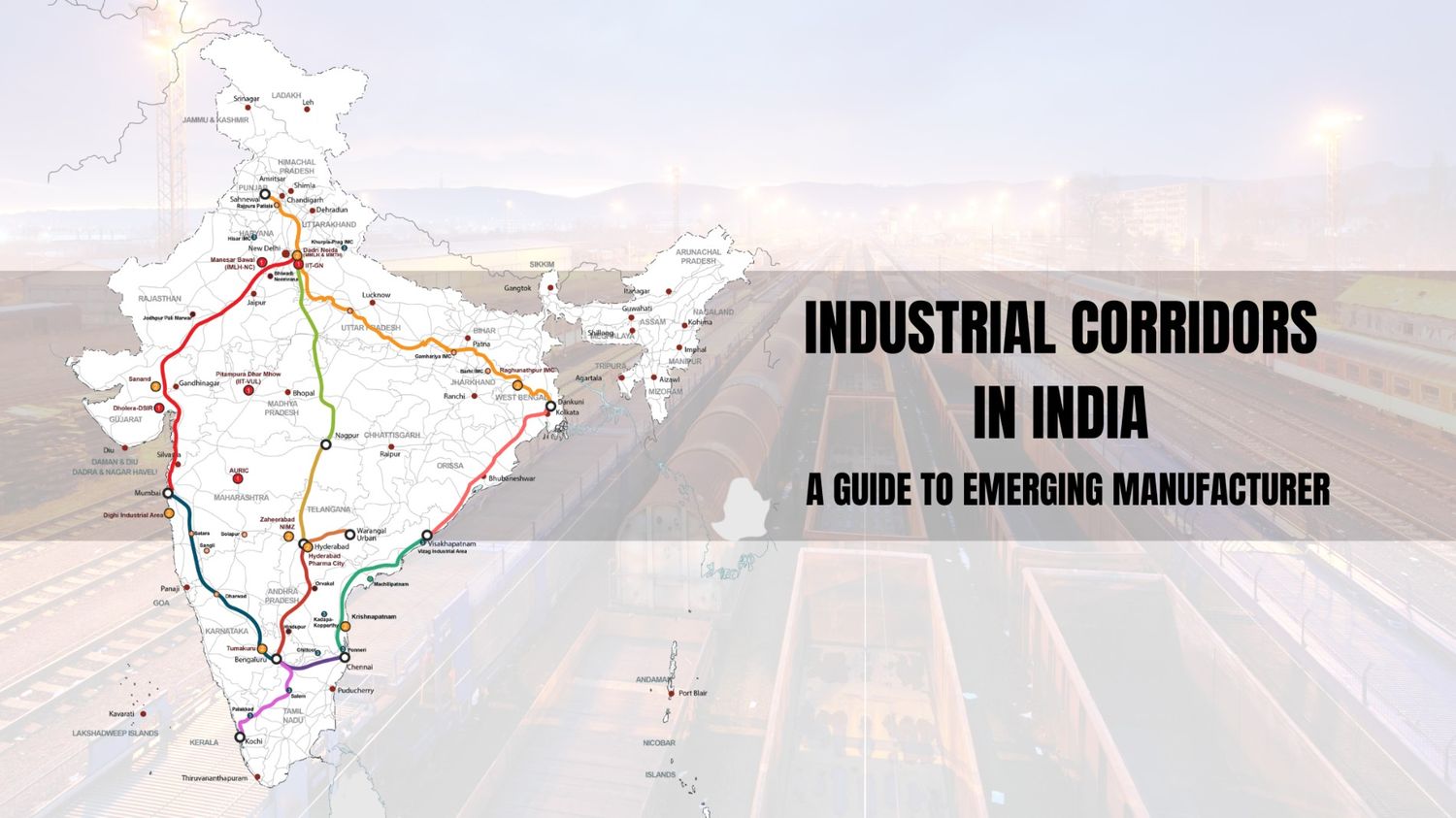
A factory does not operate in isolation. Its performance depends on how quickly raw materials arrive, how reliably utilities are supplied, where workers live and how easily finished goods reach customers, ports or logistics terminals.
This is the gap that industrial corridors aim to address. Instead of developing isolated industrial estates, India is planning larger economic regions connected by freight railways, highways, ports, airports and industrial cities.
Industrial corridors in India are expected to influence where the next generation of factories, warehouses and supplier networks will be built. For manufacturers and investors, understanding their structure, major locations, and development status is essential before choosing a future industrial site.
What Is an Industrial Corridor?
An industrial corridor is a planned development belt created along an important transportation route. It connects industrial nodes with freight infrastructure, logistics facilities, utilities and urban centres.
The corridor itself may pass through several states. Within it, selected locations are developed as industrial areas, investment regions, smart cities or multimodal logistics hubs.
How It Differs from an Industrial Estate
A conventional industrial estate generally provides plots and basic services within a defined area. An industrial corridor operates at a much larger regional scale.
Its development may include:
- Dedicated freight railways
- National highways and expressways
- Ports and airports
- Industrial cities and manufacturing clusters
- Warehouses and multimodal logistics parks
- Power, water and digital infrastructure
- Residential and social facilities
The National Industrial Corridor Development Programme aims to establish future-ready industrial cities that can compete with global manufacturing and investment destinations. (NICDC)
The objective is not only to provide land, but also to reduce infrastructure gaps and improve coordination between manufacturing, logistics, and urban development.
Major Industrial Corridors in India
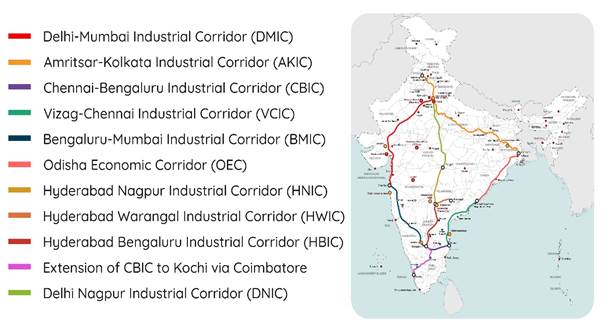
India’s industrial corridor programme covers different parts of the country. Each corridor responds to regional strengths, freight routes, ports, and existing industrial clusters.
Delhi–Mumbai Industrial Corridor
The Delhi–Mumbai Industrial Corridor, or DMIC, is one of the country’s most advanced corridor programmes. It follows the Western Dedicated Freight Corridor through Uttar Pradesh, Haryana, Rajasthan, Madhya Pradesh, Gujarat and Maharashtra.
Its location gives manufacturers access to the large consumer markets of northern India and the industrial and port infrastructure of western India.
Major projects connected with this corridor include Dholera Special Investment Region in Gujarat, Shendra-Bidkin Industrial Area in Maharashtra, Vikram Udyogpuri in Madhya Pradesh and logistics hubs in Haryana and Greater Noida.
Amritsar–Kolkata Industrial Corridor
The Amritsar–Kolkata Industrial Corridor follows the Eastern Dedicated Freight Corridor. It extends across Punjab, Haryana, Uttarakhand, Uttar Pradesh, Bihar, Jharkhand and West Bengal.
The corridor can support agro-processing, textiles, consumer goods, engineering and logistics. It also has the potential to connect manufacturing regions with large labour and consumption markets across northern and eastern India.
New industrial nodes have been approved at Khurpia, Rajpura–Patiala, Hisar, Agra, Prayagraj and Gaya.
Chennai–Bengaluru Industrial Corridor
This corridor connects two of southern India’s most established industrial economies. Chennai and its surrounding region have strong automobile, electronics, engineering and port-based industries.
Bengaluru contributes aerospace, electronics, technology and advanced manufacturing capabilities. The Tumakuru Industrial Area in Karnataka is one of the important projects being developed within this wider region.
Vizag–Chennai Industrial Corridor
The Vizag–Chennai Industrial Corridor is the first phase of the East Coast Industrial Corridor. It follows Andhra Pradesh’s coastline and connects industrial locations with ports and major transport networks.
The Krishnapatnam Industrial Area is among the projects nearing completion. Kopparthy and Orvakal are newer approved nodes that can add manufacturing capacity in Andhra Pradesh. (NICDC)
Port access makes this corridor relevant for engineering, food processing, renewable-energy equipment, chemicals and export-oriented production.
Other Important Corridors
The Bengaluru–Mumbai, Hyderabad–Nagpur and Hyderabad–Warangal industrial corridors can support industrial growth across parts of Karnataka, Maharashtra and Telangana.
The Odisha Economic Corridor is important for metals, minerals, downstream engineering, chemicals and port-led industries. The Union Budget 2026–27 also announced an Integrated East Coast Industrial Corridor under the Purvodaya initiative, indicating continued focus on the development of eastern India. (Union Budget 2026–27)
New Industrial Cities and Manufacturing Nodes
Industrial corridors become useful to investors when planned nodes move from announcements to land development, infrastructure construction and allotment.
Dholera, Shendra-Bidkin, Integrated Industrial Township Greater Noida and Vikram Udyogpuri are identified among the developed projects under the national programme.
Tumakuru, Krishnapatnam and other nodes are progressing through different stages of infrastructure implementation.
Twelve New Projects
In August 2024, the Government of India approved 12 additional projects under the National Industrial Corridor Development Programme. Their combined project cost was ₹28,602 crore. (Press Information Bureau)
The approved locations include:
- Khurpia, Uttarakhand
- Rajpura–Patiala, Punjab
- Hisar, Haryana
- Agra and Prayagraj, Uttar Pradesh
- Gaya, Bihar
- Dighi Port, Maharashtra
- Jodhpur–Pali–Marwar, Rajasthan
- Kopparthy and Orvakal, Andhra Pradesh
- Zaheerabad, Telangana
- Palakkad, Kerala
These projects extend planned industrial development beyond the country’s traditional manufacturing clusters.
By April 2026, the Government had approved 20 industrial smart cities covering seven industrial corridors and 13 states. (Press Information Bureau)
How Industrial Corridors Help Manufacturers
The main value of an industrial corridor is not its size. It is the possibility of coordinating manufacturing with transportation, utilities and supporting infrastructure.
Better Freight Connectivity
Factories located near freight railways, expressways or ports can reduce unnecessary road travel and improve shipment reliability. This is particularly relevant for high-volume, export-oriented and logistics-intensive industries.
Planned Infrastructure
Industrial cities may provide external roads, drainage, power distribution, water supply and digital services. This can reduce the amount of off-site infrastructure that an individual company must arrange.
As of May 2026, India had around 272 operational plug-and-play industrial parks. Another 20 smart cities and industrial areas were being developed under NICDC. The BHAVYA scheme also proposes 100 new plug-and-play industrial parks across the country. (Press Information Bureau)
Supplier and Employment Clusters
Large anchor industries often attract component manufacturers, service providers, warehouses and transport operators. Over time, this can create a more reliable local supply chain.
Planned residential and social infrastructure can also make it easier to attract and retain employees, especially at greenfield locations away from existing cities.
Key Takeaways for Industrial Site Selection
Before choosing a site within an industrial corridor:
- Map suppliers, customers, ports and logistics terminals.
- Verify the land title, possession status and permitted industrial use.
- Check the completion status of external infrastructure.
- Confirm power, water, gas and effluent-disposal capacity.
- Study local labor availability and employee transportation.
- Review environmental and statutory approval requirements.
- Inspect last-mile roads for heavy-vehicle movement.
- Understand the depth of the local vendor ecosystem.
- Compare state incentives with long-term operating costs.
- Plan sufficient land and utilities for future expansion.
- Study flood levels, drainage and local climate risks.
- Align the location with the factory’s construction schedule.
Conclusion
Industrial corridors in India are creating a wider and more connected manufacturing landscape. Established western and southern clusters continue to grow, while newer nodes across northern and eastern India are opening additional investment possibilities.
The right location should not be selected only on land price, incentives or its presence on a corridor map. A successful industrial site is one where freight connectivity, utilities, labor, approvals, supply chains and future expansion can support the factory throughout its operating life.
Frequently Asked Questions
- What Is the Purpose of an Industrial Corridor?
An industrial corridor connects manufacturing areas with freight transport, logistics hubs, utilities and urban infrastructure to support industrial and regional development.
- Which Is the Most Advanced Industrial Corridor in India?
The Delhi–Mumbai Industrial Corridor is among the most advanced, with developed projects such as Dholera and Shendra-Bidkin.
- Which Industries Can Benefit from Industrial Corridors?
Automotive, electronics, engineering, renewable energy, food processing, textiles, chemicals, pharmaceuticals and logistics-intensive industries can benefit, depending on the location.
- Is Land Within an Industrial Corridor Ready for Construction?
Not always. Land availability, trunk infrastructure, approvals and utility connections must be verified for the specific node and plot.
VMS provides integrated architecture, engineering and project management services for industrial projects across India. Connect with VMS to evaluate, plan and develop a manufacturing facility aligned with your location and operational requirements.