

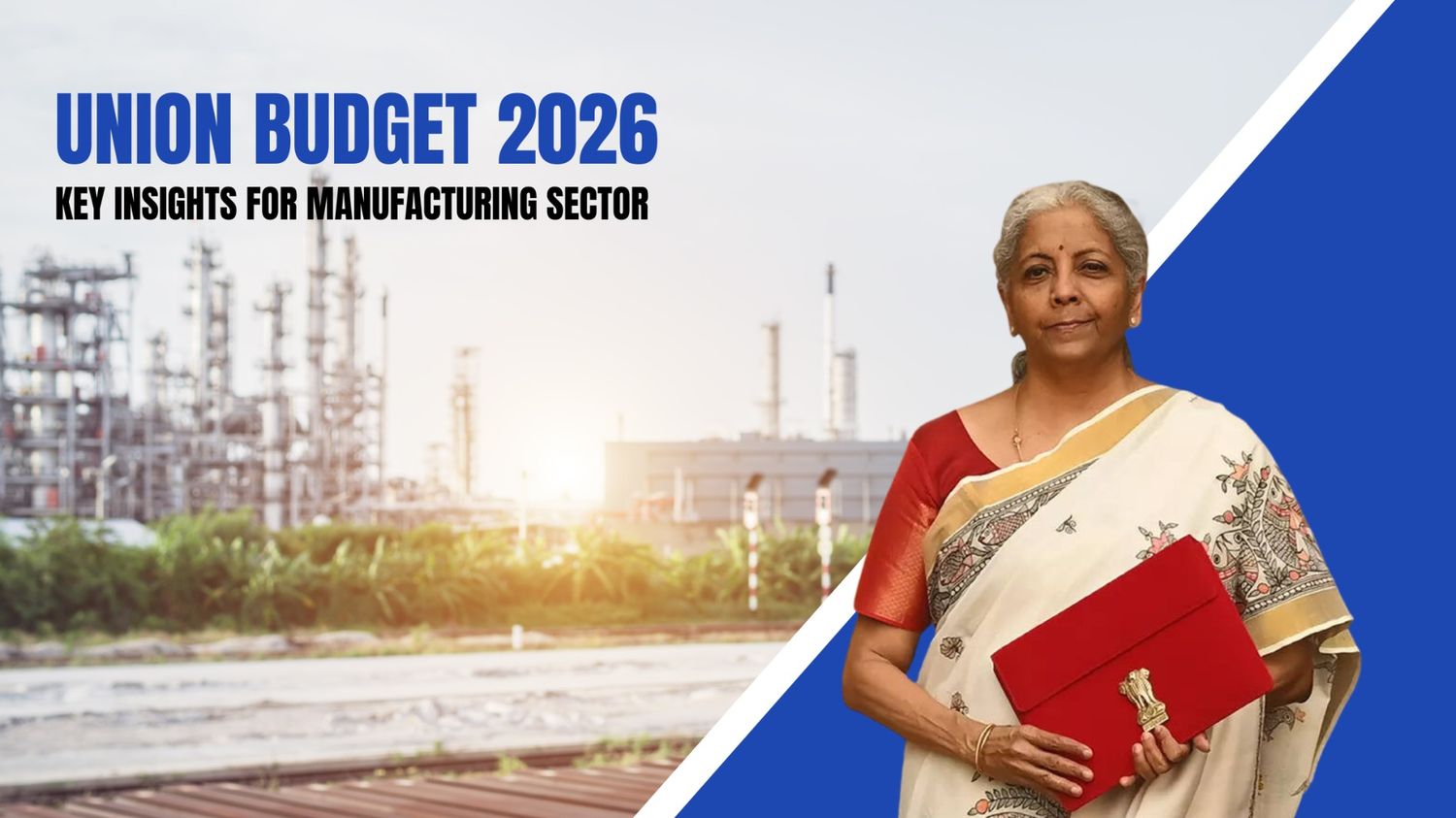
Union Budget 2026: Key Insights for Manufacturing and Factory Operations
The Union Budget 2026–27, presented by Finance Minister Nirmala Sitharaman, places a strong emphasis on strengthening India’s manufacturing base and improving overall factory operations.
A key objective of this budget is to keep economic growth strong, support strategic industries, and expand employment opportunities across all sectors.
India’s manufacturing sector remains a cornerstone of its long-term economic vision, and Budget 2026 highlights key reforms intended to boost productivity, attract investments, and enhance global competitiveness.
This article breaks down the most relevant takeaways from an operational and industrial perspective.
1. The Focus on Manufacturing Sector
The Union Budget 2026 focuses on scaling up manufacturing in seven strategic and frontier sectors, pushing India closer to self-reliance and export competitiveness.
Key Manufacturing Initiatives
- India Semiconductor Mission 2.0
- Biopharma SHAKTI
- Electronics Components Manufacturing Scheme
- Integrated Textile Programme
- Three Dedicated Chemical Parks
- Rare Earth Permanent Magnet Scheme
- Container Manufacturing Scheme
- Sports Goods Manufacturing Initiative
- Revival of 200 Legacy Industrial Clusters
- Hi-Tech Tool Rooms in CPSEs
The policy intent behind these allocations is clear: diversify India’s manufacturing base, reduce import dependence, and foster innovation-led growth.
2. Increased Capital Expenditure and Infrastructure Support
A key highlight of the 2026 budget is the significant increase in public capital expenditure, proposed at around INR 12.2 lakh crore for FY 2026–27.
Higher capex signals stronger support for industrial infrastructure, logistics networks, and essential utilities that directly impact factory operations. Better roads, ports, and connectivity reduce manufacturing lead times and supply chain costs.
For factory owners and construction planners, this means a more predictable environment to invest in production capacity and expansion projects.
3. Incentives for Strategic and Frontier Manufacturing
Budget 2026 continues to offer production-linked incentives (PLI) and extends incentives for sectors like electronics manufacturing and AI data-centre infrastructure.
The expansion of PLI schemes supports both small and large manufacturing units, encouraging technology adoption and localisation. Tax benefits and clarity for electronics and semiconductor manufacturing help reduce entry barriers for advanced factory setups.
In parallel, long-term tax exemptions for cloud services, data centres, and AI infrastructure encourage digital adoption within industrial setups, which is critical for modern manufacturing operations.
4. Supporting MSMEs
Micro, Small & Medium Enterprises (MSMEs) contribute significantly to India’s industrial output and exports. They account for nearly 30% of GDP and over 45% of merchandise exports.
Budget 2026 emphasises empowering MSMEs through improved access to credit, streamlined financing, and dedicated growth funds such as a ₹10,000 crore SME Growth Fund.
This support is essential for manufacturers and factory units that depend on MSME suppliers for components and services. Enhanced liquidity and credit guarantee frameworks ease working capital constraints and create a more resilient supply chain.
5. Special Economic Zone (SEZ) Reforms
A one-time measure allows manufacturing units in Special Economic Zones (SEZs) to sell products domestically at concessional duty rates, offering temporary relief amid global trade challenges.
This flexibility can help manufacturing firms pivot to domestic markets without heavy tariff burdens, improving utilisation of factory capacity during periods of export slowdown.
6. New Plug-and-Play Industrial Infrastructure
The budget introduces plans for plug-and-play chemical parks and Hi-Tech tool rooms to support precision and advanced manufacturing.
These facilities shorten factory setup times, reduce capital outlays, and offer shared infrastructure for small and mid-sized units. Manufacturers will benefit from a simplified roadmap for launching operations with state-of-the-art infrastructure.
7. Sectoral Boosts For EVs, Auto, and Rare Earths
Budget 2026 provides continuity in critical areas like electric vehicle (EV) manufacturing, including duty exemptions on EV battery inputs, promoting local production.
Additionally, dedicated Rare Earth Corridors in states like Odisha, Tamil Nadu, and Andhra Pradesh aim to strengthen domestic supply chains for crucial materials used in electronics and clean-energy sectors.
These initiatives signal opportunities for factory operations tied to clean energy, automotive components, and high-precision manufacturing.
8. Tax and Customs Reforms for Manufacturers
The 2026 budget proposes tax and customs reforms favourable to manufacturers, including deferred duty payment windows, income tax exemptions for certain suppliers of capital goods, and expanded duty-free import for specific inputs.
These reforms lower production costs and support factories dependent on imported machinery and components, especially in heavy industries where capital equipment costs are a major expense.
9. Energy Transition With ₹20,000 Crore
A commitment of Rs 20,000 crore for Carbon Capture Utilization and Storage over a five-year period represents one of the biggest industrial decarbonization projects in India.
A combination of customs exemptions for renewable manufacturing inputs and excise rationalization for biogas-blended CNG in this Budget lowers the economic barrier by lowering costs rather than introducing new ones.
Factors to Consider For Manufacturers with Budget 2026
To make the most of the opportunities presented in Union Budget 2026:
- Plan for Expansion with available PLI and capex-linked incentives.
- Leverage Infrastructure Growth to scale factory operations efficiently.
- Strengthen Supply Chains by partnering with MSMEs and utilising SEZ reforms.
- Adopt Modern Technologies such as automation and IoT for competitive advantage.
- Consider Sustainability as a long-term operational strategy.
Final Thoughts
How manufacturers translate policy intent into operational improvements will determine the true impact of the policy. For factory owners and plant teams, preparedness will matter more than announcements.
Those who align early with infrastructure growth, technology adoption, and supply chain resilience will be better positioned to compete in India’s evolving manufacturing landscape.