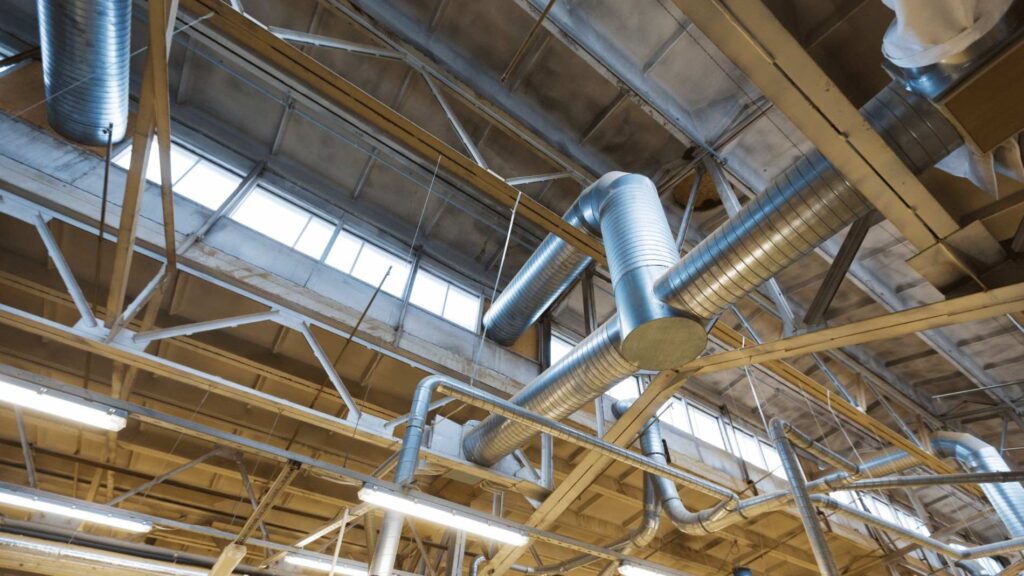

Industrial buildings are rarely quiet places. Compressors start and stop, motors operate continuously, presses generate sudden impacts, HVAC systems move large volumes of air, and material-handling systems run across production areas.
Noise itself is not always the problem. The bigger design question is where that noise and vibration will travel, who or what will be exposed to it, and how it may affect the building, equipment, people and surrounding environment.
This is why acoustic control should not be treated as something to be addressed only after a factory becomes operational. Many of the most effective decisions are made much earlier, while the plant layout, building envelope, structural system and building services are still being designed.
Good industrial acoustic design therefore begins with understanding how sound and vibration move through a facility.
What Are Noise and Vibration Problems in Industrial Buildings?
Noise and vibration are closely connected, but they do not behave in the same way.
Understanding this difference is important because the design solution that works for one may not necessarily work for the other.
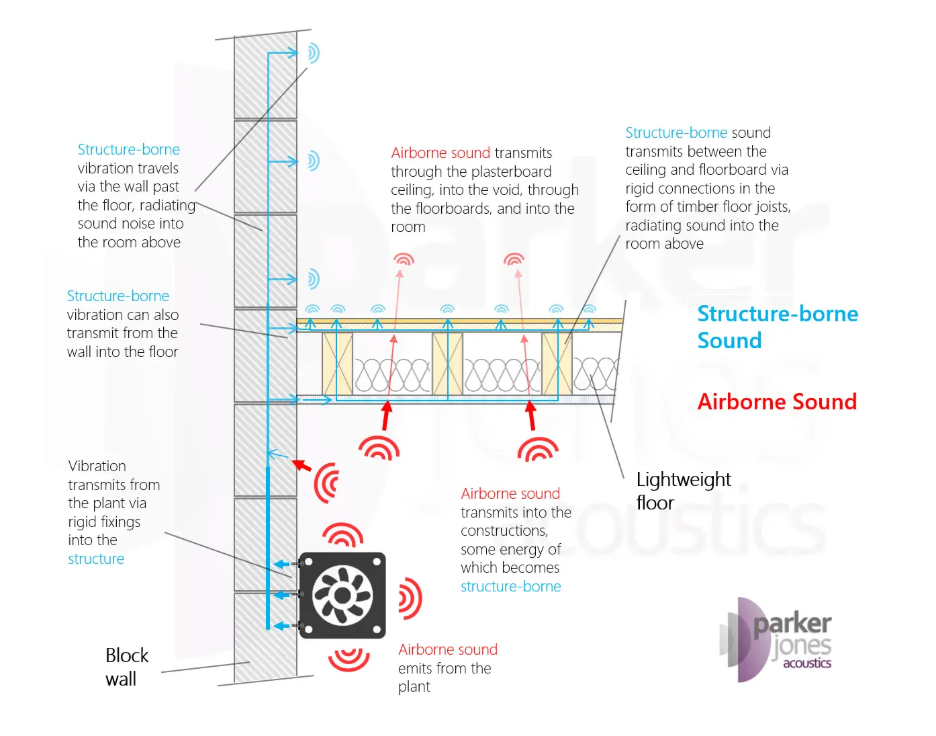
Airborne Noise
Airborne noise travels through air. Fans, blowers, pneumatic equipment, engines and production machinery are common sources.
The sound can pass through doors, ventilation openings, ducts, glazing and lightweight building elements before reaching other parts of the facility.
Structure-Borne Noise and Vibration
Structure-borne noise begins as vibration. A compressor, stamping machine or rotating equipment can transfer energy into its foundation or supporting structure.
The vibration may then travel through slabs, columns or structural framing before being heard or felt somewhere else.
A wall designed to reduce airborne sound, for example, may do very little if vibration is travelling underneath it through a common floor slab.
This distinction changes the way an acoustic problem needs to be approached.
How Does Noise Travel Through Industrial Facility?
A useful way to understand industrial noise and vibration is through three elements:
Source → Transmission Path → Receiver
The source is where the noise or vibration originates like a machine, fan, compressor, pump, DG set or production process.
The transmission path is how that energy moves. It could travel through air, a concrete slab, structural steel, ductwork, piping, openings or other building components.
The receiver is whoever or whatever is affected. This could be an operator, control room, office, laboratory, sensitive equipment or even a neighboring property.
Effective acoustic design can intervene at any of these three points. In practice, the best results often come from addressing several of them together.
Consider a compressor located beside a control room. Increasing the wall specification alone may not solve the problem. Noise could still pass through the door or ventilation duct, while vibration could travel through the common floor slab.
The complete transmission path needs to be understood before deciding on the solution.
Why Should Noise and Vibration Be Considered During Early Planning?
Some of the most effective acoustic decisions do not involve specialized acoustic products at all.
They involve deciding where equipment, people and buildings should be located before the layout becomes fixed.
Separate Noisy and Sensitive Areas
Where operations permit, high-noise equipment can be grouped and separated from offices, meeting rooms, laboratories, control rooms and other noise-sensitive areas.
Stores, utility areas, circulation zones or service corridors can sometimes serve as useful buffers between noisy production areas and quieter occupied spaces.
Distance itself can become an effective first line of control.
Consider Noise While Orienting the Building
External equipment such as cooling towers, DG sets and utility systems should be located with an understanding of surrounding site conditions.
Positioning a major noise source without considering nearby residential or commercial development can turn an internal engineering issue into an environmental concern.
This is particularly relevant in India, where expanding cities and industrial development increasingly meet at their boundaries.
Under India’s Noise Pollution (Regulation and Control) Rules, the ambient noise standard for industrial areas is 75 dB(A) Leq during daytime and 70 dB(A) Leq at night.
Acoustic planning therefore needs to consider both the environment inside the factory and what happens beyond the site boundary.
How Can Noise Be Controlled in an Industrial Building?
Once the sources, transmission paths and sensitive areas are understood, noise control can be approached in layers.
The objective should not necessarily be to add acoustic treatment everywhere. It should be to intervene where the treatment will have the greatest effect.
Step 1: Reduce Noise at the Source
The first priority should generally be to reduce noise before it spreads through the facility.
This can begin with equipment selection itself.
Lower-noise fans, appropriately sized motors, balanced rotating machinery and properly maintained bearings can reduce the acoustic load before additional architectural treatments become necessary.
International occupational-health guidance similarly prioritizes equipment selection and engineering controls rather than depending primarily on hearing protection.
Where machinery cannot be made sufficiently quiet at the source, partial or complete acoustic enclosures may be considered.
But an enclosure cannot be designed only around acoustic performance.
Industrial equipment still needs cooling and ventilation. Operators need inspection access. Maintenance teams need space to service components. Materials may need to enter and leave the machine.
The most effective solution is therefore not necessarily the enclosure with the highest theoretical sound reduction. It is the one that achieves the required acoustic performance without compromising production, ventilation, access or maintenance.
Step 2: Control Noise Through the Building Envelope
Industrial buildings commonly use large-span steel structures with lightweight roofing and cladding systems. These systems are efficient for construction, but their acoustic behavior needs to be considered during design.
Sound does not escape only through walls.
Roof assemblies, louvers, ventilation openings, loading doors, glazing, service penetrations and gaps around ducts can all become weak points.
A high-performing wall, for example, offers limited benefit if a large untreated ventilation opening sits beside it.
The building envelope therefore needs to be considered as a complete acoustic system rather than as a collection of individual materials.
Step 3: Manage Reflected Noise Inside Large Spaces
Another issue arises inside large production halls.
Metal roofing, wall cladding and concrete floors create extensive hard surfaces. Sound can repeatedly reflect between these surfaces, increasing reverberation and contributing to the overall noise experienced by workers.
Strategically positioned absorptive materials, acoustic ceilings or suspended baffles can help control these reflections.
However, reducing reverberation inside a building is different from preventing sound from leaving it.
Absorptive treatment may improve acoustic conditions within a production hall, while sound isolation depends on controlling transmission through the envelope, openings and adjoining structures.
The two problems often require different solutions.
What Role Do Building Services Play in Noise Control?
Not every transmission path is architectural or structural.
HVAC systems, piping, pumps and other building services can carry noise and vibration from one part of an industrial facility to another, sometimes over considerable distances.
HVAC and Duct-Borne Noise
A fan or air-handling unit may generate noise at one location while ductwork carries that sound to another part of the facility.
Depending on the system and required performance, acoustic treatment may involve equipment selection, duct design, attenuators, flexible connections or vibration isolation.
Piping and Mechanical Connections
Pumps, piping and other mechanical services can create similar problems.
Even when a machine is properly isolated from the floor, rigid piping or duct connections can unintentionally create another path for vibration to enter the structure.
Service Penetrations
Penetrations through walls and partitions also need coordination.
An acoustically rated partition can lose much of its effectiveness if openings around ducts, cables or pipes are not appropriately addressed.
Acoustic performance therefore needs to be considered as part of MEP design and coordination rather than only as an architectural requirement.
How Should Machinery Vibration Be Controlled?
Heavy and rotating machinery introduces a different design question:
How should the machine connect to the building?
Simply placing equipment on a thicker concrete slab does not automatically solve a vibration problem.
Select the Appropriate Isolation Strategy
Depending on the equipment and operating conditions, solutions may include:
- Independent machine foundations
- Inertia blocks
- Elastomeric pads
- Spring isolators
- Other engineered isolation systems
The appropriate solution depends on how the equipment operates and how its dynamic forces interact with the supporting structure.
Consider Dynamic Loads
For the structural engineer, static equipment weight is only part of the information required.
Operating speed, dynamic forces and frequencies can influence how the machine interacts with its supporting structure.
The foundation, structural system and vibration-isolation strategy therefore need to be considered together.
Coordination becomes particularly important because vibration can bypass an otherwise effective isolation system through rigid piping, ducts or other connections.
Vibration control consequently sits at the intersection of structural, mechanical and architectural design rather than belonging entirely to one discipline.
What Information Is Needed Before Designing Acoustic Controls?
Good acoustic design depends on good equipment information.
Depending on the equipment, relevant inputs may include:
- Equipment weight
- Operating speed
- Dynamic forces
- Operating frequencies
- Manufacturer noise data
- Operating duration and schedule
- Continuous or intermittent operation
- Steady or impulsive noise characteristics
The way multiple machines operate together also matters.
A machine operating occasionally may present a very different acoustic condition from several pieces of equipment running simultaneously throughout a shift.
The earlier this information is available, the better the project team can evaluate its effect on the layout, structure, building services and surrounding spaces.
Acoustic design therefore also depends on coordination between equipment suppliers, process teams, architects and engineers.
Why Is Acoustic Design Also a Workplace Safety Issue?
Industrial noise is not simply an issue of comfort.
It can directly affect worker exposure, communication and the ability to recognize important safety information.
Occupational Noise Exposure
NIOSH considers repeated workplace exposure at 85 dBA or above hazardous and recommends 85 dBA as an eight-hour occupational exposure limit.
Its guidance also recognizes that allowable exposure duration decreases significantly as noise levels rise.
India’s Model Factories Rules similarly address continuous and impulsive noise exposure and call for engineering or administrative controls, followed by suitable hearing protection where exposure cannot practically be reduced sufficiently.
Communication and Situational Awareness
High background noise can make verbal communication difficult on a production floor.
Instructions may be misunderstood, while alarms and warning signals can become harder to recognize.
NIOSH also notes that high workplace noise can reduce situational awareness and contribute to accidents and injuries.
Acoustic design should therefore consider not only overall noise levels but also the conditions around operators, control rooms, communication points and safety systems.
It becomes part of industrial safety planning rather than simply an issue of comfort.
How Can Acoustic Performance Be Checked?
Acoustic design becomes more reliable when assumptions are converted into measurable performance criteria.
Rather than treating noise control as a one-time design activity, it can be evaluated throughout the project lifecycle.
During Design
Noise information from proposed equipment can be assessed against operator locations, sensitive rooms and site boundaries.
Potential transmission paths can then be considered while the layout, structural systems and building services are still flexible.
In Existing Industrial Facilities
For operating facilities, sound-level measurements and vibration surveys can help identify dominant sources and understand how noise is travelling through the building.
This can be particularly useful when an existing production area is being modified, expanded or fitted with new equipment.
After Commissioning
Measurements after commissioning provide an important reality check.
- Is the control room performing as expected?
- Is vibration from rotating machinery reaching adjacent areas?
- Are external noise levels acceptable at the site boundary?
- Are the measures introduced during design performing under actual operating conditions?
Post-commissioning observations can also provide useful information when planning future modifications or plant expansions.
Who Is Responsible for Noise and Vibration Control?
There is rarely a single answer.
Industrial acoustic performance is influenced by decisions made across several disciplines.
The architect influences equipment zoning, room relationships, building orientation and envelope design.
The structural engineer determines how equipment loads and vibration interact with foundations and the supporting structure.
The MEP team influences equipment selection, HVAC systems, piping, ducts, penetrations and utility installations.
The process and equipment teams provide the operating information on which many of these decisions depend.
A decision made by one discipline can therefore affect the acoustic performance of another.
For multidisciplinary industrial projects, this is where an integrated design approach becomes valuable. At VMS, noise and vibration considerations can be coordinated alongside industrial planning, architecture, structural engineering and building services rather than being treated as an isolated issue late in the project.
Final Thoughts
Noise is invisible, which perhaps makes it easier to underestimate during design.
A production line may fit perfectly within the available space. A machine foundation may satisfy its static structural requirements. The building envelope may perform well from a weather and thermal perspective.
Yet the completed facility can still experience an acoustic problem if no one has considered how noise and vibration will travel once operations begin.
The more useful question is therefore not simply:
“How noisy is this machine?”
It is:
“Where will that noise and vibration go once the machine starts operating?”
When that question is asked during planning rather than after commissioning, noise and vibration control becomes part of good industrial design.